Feeds:
Posts
Comments

GTD or DFN?

You’ve heard of GTD haven’t you? It’s everywhere on the web (3,260,000 hits if you google it!) It stands for “Getting Things Done” and was invented by David Allen. Put simply, its a system to try and help you beat procrastination and clutter by focussing on actually doing what needs done instead of just thinking about it and hoping that one day you might get round to it. The basic idea is a good one – that things that need done but which you haven’t done yet clog up your brain like clutter clogs up your house. However, as with all “systems”, (especially ones which get trademarked), it all gets a bit too complicated for its own good. Zen habits is a personal organisation blog which I like and here you’ll find a simplified version of GTD.

I confess. I love notebooks and pens and diaries and calendars so this whole thing catches my attention. I’ve even read the book! More than that, I’ve changed my home filing system to the simple one he suggests and I try pretty regularly to action or file the pile of mail that heaps up on my kitchen windowsill – clearing that windowsill is a strangely life-enhancing experience!

But I’ve been on holiday for the last week and as I’ve had a busy week of NOT Getting Things Done (NGTD), an Italian phrase popped into my head for some reason –

Dolce Far Niente

First time I saw this I wrote it in the front of my then current Moleskine. In English it would mean “Doing sweet nothing”. I can remember when I was a busy GP rushing from surgery to housecalls and cutting through Holyrood Park. I would often see someone sitting on one of the park benches. Just sitting. And I’d think “How wonderful! To be able to just sit! No bag. No phone! Just sitting!” That’s one version of “Dolce Far Niente” (DFN). You can make up your own. What’s your favourite way to enjoy doing sweet nothing?

While thinking about this post I came across this painting by John William Godward

It’s entitled “Dolce Fa Niente”

Dolce Far Niente

clouds over water, originally uploaded by bobsee.

I find water so fascinating. In all its forms.
Clouds are lovely. They manage to look solid and soft and substantial and impermanent all at once.
Here’s a photo I took looking down on the clouds as I flew over the French coast.
What’s really amazing here is how you can see the shadows of the clouds on the surface of the sea.
Water reflected on water
Water moving over the face of the water.
Shadows of heaven on earth

raindrops on leaves, originally uploaded by bobsee.

I can’t stop myself photographing water! I love to see drops of water like this on a leaf or a petal. The perfect shapes, the way water sits in droplets on leaves reflecting the light of the world. You can see whole worlds in there. You can see LIFE in there.
It’s beautiful

Choose hope

rainbow over castle, originally uploaded by bobsee.

What’s the significance of a rainbow? Is there a pot of gold at the end of it? In this case it looks like the pot of gold must be in Stirling Castle!
The rainbow is a hopeful symbol isn’t it? This beautiful one which I saw on wednesday made me think of the two states I often see as a doctor – hopelessness and hopefulness.
Some doctors tell people how long they’ve got to live. Usually these are people with cancer. But these prognoses are just based on statistics. For this individual who sits with me today I have no way of telling how they’re life will progress let alone of telling when they’re going to die. More than once I’ve told patients that having a disease doesn’t give you knowledge of when you’re going to die.
Pretty much in every condition a doctor will see someone who gets worse, someone who doesn’t get better and someone who does. The proportions of people in each of these categories changes with different diseases. But there are ALWAYS people who defy expectations. Look at Stephen Hawking. He has Motor Neurone Disease and most people with this disease die within a couple of years of diagnosis. Stephen Hawking has had this disease over 40 years now.
Patients with any disease have a choice about how to live their lives. They can choose to give up in despair, or they can choose to hope. A doctor’s job includes helping patients to choose hope – realistic hope, not crazy hope!

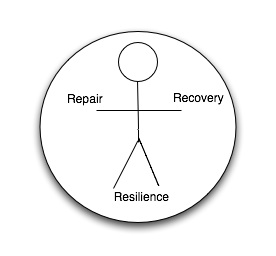
rrr.jpg

Here’s a diagram I drew last night.

This works for me as a symbol of what health care should do.

In the middle we see the symbolic representation of a person. All health care should be focussed on the individual. It’s this person with me today who needs my attention. It’s this person in their uniqueness who needs to be understood and cared for. It’s the whole of this person who is with me today (not just the bit of them that’s not working!)

There are three Rs –

  1. Repair
  2. Recovery
  3. Resilience

Most treatments are directed at repair. Dilating constricted airways, reversing spasm of arteries, killing infecting organisms etc. But we only become well again by recovering from an illness. If we have an infection then an appropriate antibiotic might kill the bacteriae but it’s our body’s processes of healing and recovering which restore our tissues and our whole beings to health. The processes of recovery are not so well understood and very few medical interventions claim to stimulate or enhance recovery, but we see reports like this which show that the patients’ emotional state influences recovery for example and some research has shown that the physical environment in which a patient is nursed influences recovery. In other words, recovery is not about just dealing with the disease, recovery is about addressing the whole person in the context of their environments.

Finally, after recovery, can we do anything to reduce the chances of this person falling ill this way again? Can we increase their resilience? So much of preventitive health these days is a technical fix – drugs – drugs to lower blood pressure and cholesterol for example – but the best way to be healthy and to stay healthy is to be more resilient – and that involves not just the physical body but the whole person in the context of their life. Not so much is understood about resilience and very, very little exists in health care to specifically address and enhance an individual’s resilience.

Wasn’t it Benjamin Franklin who said

God heals and the doctor takes the fees

Well, that’s not good enough any more. We need more research to understand the processes of recovery and resilience and we need to ask the question of health care – how does this intervention address the patient’s needs for Repair, Recovery AND Resilience? And if the intervention ONLY addresses repair, then what else are we going to do to address both Recovery and Resilience? Because without addressing these needs we are fighting a continually losing battle of repeated repairs.

When the NHS was created in the UK, the Labour government genuinely believed that providing health care for all would so improve the health of the nation that the costs of the service would fall year by year. It never happened. Quite the reverse. Why? Because they created a National Repair Service, not a National Health Service. (well, that’s part of the reason, another part is that health is a much more complex phenomenon than can be addressed by a health care service – poverty, housing, sanitation, education and work and so on are HUGE influences on health experience too)

There’s one final element to this little drawing. The circle around the person. This represents understanding that we need to address a whole individual within the context of their life, and also represents that a person needs cared for by a circle of carers. Health including recovery and resilience is influenced by that complex network of individuals – professionals, friends and relatives who surround the person.

Fundamentally, though, the circle represents CARE – nobody really gets better unless someone cares for them. All health care should be delivered by people who CARE.

Blind Light1, originally uploaded by bobsee.

I went to the Hayward Gallery in London last week to see Antony Gormley‘s Blind Light Exhibition. I’ve always been enormously impressed with his work, ever since I first saw The Field in Inverleith House in the middle of Edinburgh’s Royal Botanic Gardens.
This is a fabulous exibition. It really makes you experience the issues of separateness, of how we all live all lives inside our bodies and how we connect from there to the outside world, how we fit and how we change the world we live in.
The exhibition starts as you walk to the Hayward which is on the South Bank. On the buildings far and near you begin to become aware of standing figures. These are all casts of Antony Gormley’s body. The more you see of them the more you see of them! Echoing each other into the distance, some near and looming large, some tiny and in the distance, and always, always they make you appreciate the scale of the urban landscape and the scale of a single person.
Stunning. Come and see.

I’ve just started reading Sebastian Faulks’ Human Traces. On page 21 this sentence struck me

Do we already possess all we need to stop feeling the world as the sound of footsteps and the ache of our backs and to look up – to the woods and the hills and the oceans that stretch out in their immensity, just waiting to be seen?

I’m in the habit of drawing simple little diagrams to explain things to patients. I draw one which is just a circle. I say “This circle represents your life”. Then I draw a much, much smaller circle inside the first one and I say “When we have chronic pain, or sadness, or breathlessness, or stiffness, or whatever, our life becomes much smaller. Maybe we can’t go out so much. Maybe we can’t face other people. Maybe everything loses its joy. It’s necessary to do this to survive sometimes. We all need to feel safe before we can grow. If the treatment I’m going to give you works it’ll reduce your symptoms and stimlate your body’s natural healing processes and so let you begin to look up and start to see that you can move outside of this constricted, safe zone, and as you do, your world will start to get bigger and more enjoyable again. Then we’ll know you are getting well.”

We don’t grow with our heads down. We grow when we look “to the woods and the hills and the oceans that stretch out in their immensity”

These are the hills I see from my bedroom window

A site called TED

If you haven’t discovered it yet, take a look at http://www.ted.com

There are loads and loads of interesting, educational and entertaining videos of presentations and talks.

Start here.  This is a talk by Frans Lanting, a wonderful nature photographer. It’s a slideshow of his own photos that he’s put together and narrates to tell the story of LIFE, of evolution, of how LIFE is about continual becoming (see that “becoming not being……” byline at the top of my blog? You can see why this talk appeals to me).

The photos are just stunning.

Orthopaedic surgeons at St Louis University School of Medicine were a bit puzzled when their clinical tests on patients post hip surgery indicated they were recovering well but the patients own reports didn’t confirm that. What they did was ran a parallel questionnaire which amongst other things asked about emotional well-being. The two sets of results didn’t correlate

“What we found was surprising – the clinical test found good-to-excellent results, while the self-test taken by the same patients showed significantly worse recovery.”

Now, to you and me that might not be a surprise but, strangely, to these surgeons it was a shock. You know why? The surgeons see themselves as technical fixers. In this case they were fixing hips and they were assessing how well the new hips worked. But they are being confronted with the fact that the hips in question are inside people and people are a lot more complex than just the bits of their bodies.

You can’t but applaud this conclusion from Berton Moed MD

“The number one issue is recognition – we need to acknowledge that there’s more going on with patients than what current clinical tests tell us,” he says.

But wait, his suggestions for what do about this problem is worryingly medicalised –

“Do we need to look at other interventions besides fixing their hip? I think we might have to,” he says. “That could include bringing in social workers and psychologists to work with the patients in the areas that surgeons, who often are super subspecialists, may not be able to deal with.”

OK, I’ll let the “super” and “sub” bit connected to the “specialists” go for the moment but do we really need social workers and psychologists to help patients recover? Because surgeons don’t know how to address a patient’s issues and feelings?

Please, let’s recognise that people are always more than the sum of their parts and that every health care intervention should take into consideration the whole person, not just the wonky bit! Recovery, true recovery, from an operation is a complex phenomenon. If we don’t recognise this we are in danger of wasting a lot of time and good effort only doing half a job. Every surgeon and every nurse on a surgical ward should be able to address and care for the human needs of the patients in their care.

By the way, just what is a “super subspecialist”? Someone who only has the skills to deal with bits of people?

Morag Wilson, a 32 year Dietetics Manager in the NHS committed suicide by stabbing herself with a kitchen knife then throwing herself from a bridge 100 feet above the Manchester ship canal. The coroner said she was driven to this sad end by the pressures of her job. Specifically, Agenda for Change had produced very disparate outcomes for dieticians in her region and resulted in widespread resentment amongst staff. The coroner said this

“I find it extremely sad that a young woman with such a lot going for her, very dedicated to her work, has been reduced to despair by the pressure upon her at work,” he said. “When people introduce these rules and systems perhaps a bit more thought as to what effect they will have on people would be helpful.”

The NHS should be a people focussed organisation – focussed on the patients and those who deliver the health care. Targets, budgets, managerial processes, should all be measured against the impacts they will have on people. Please, can we have a health service that cares, that really cares about people?