It’s a strange phenomenon, time, don’t you think?
Sometimes it flies past, and other times it drags.
We talk of saving time…..where do we save it too? Is there a deposit safe somewhere I can draw from when I find myself in need of more time?
We talk of spending time….but where do we spend it, and who gives out the receipts?
We talk of passing time…..but what do we mean….passing it from me to you, passing it between ourselves, back and forth? Or passing it by….without noticing it?
We talk of making time…..but who can make time? “The man who made time made plenty of it”, I used to be told when I claimed I hadn’t had enough time to do something I should have done.
We talk of buying time….but who sells it, and can we buy it online or do we have to go to a shop?
We talk of wasting time….which is another way of saying we haven’t paid attention to something we should have.
We talk of having time…..but time can’t be had, can’t be kept, can’t be hold onto….it slips through our fingers like water, or grains of sand.
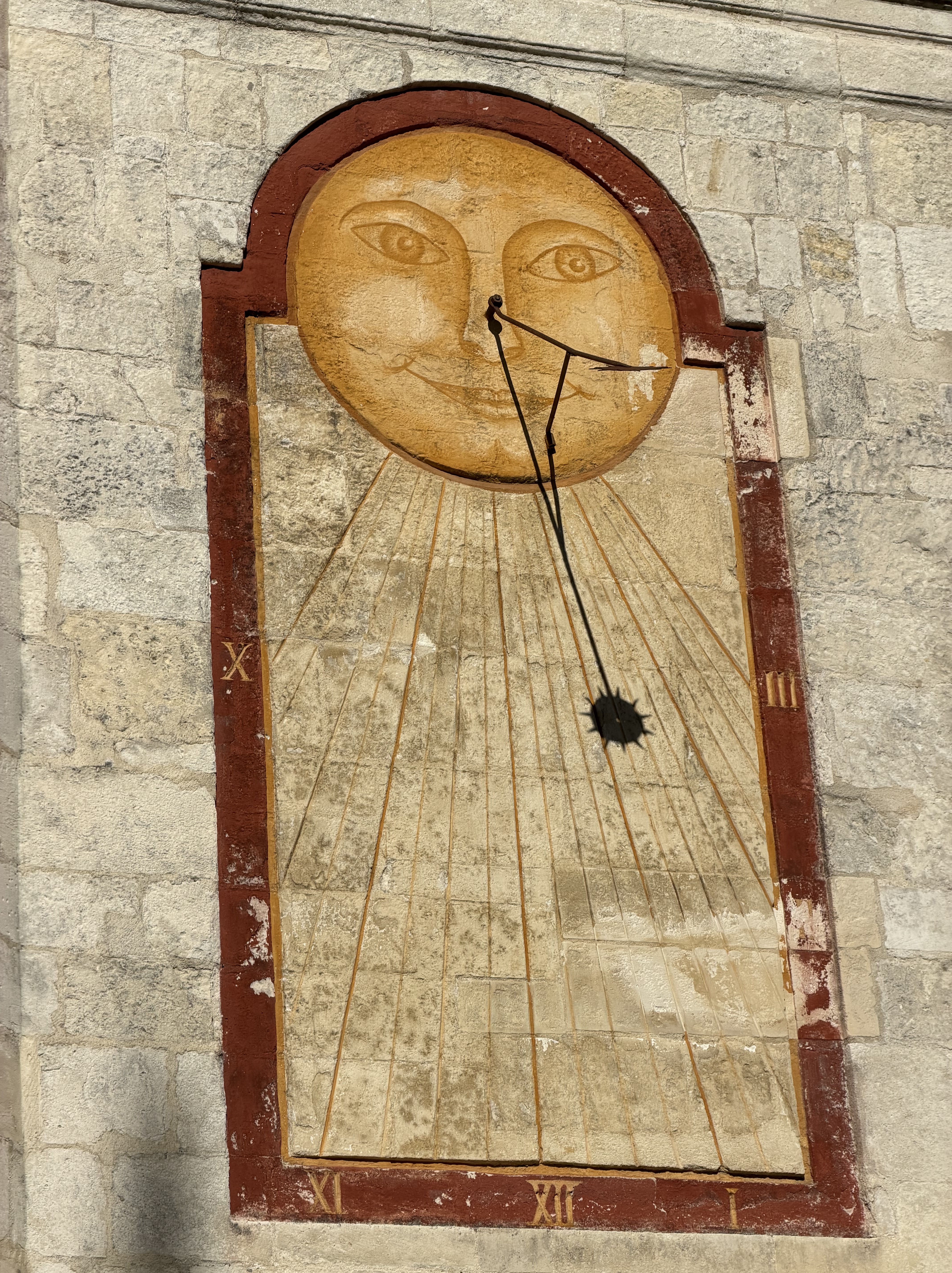
Sundials and shadow clocks were used over three thousand years ago, and water clocks, used during the night date back that far, too, but it wasn’t until the 14th century that public mechanical clocks appeared in European towns and cities. The move to mechanical clocks divided up the day into smaller, more regular pieces than sundials did, and as clockmakers improved their accuracy, they began to be used to measure seconds, as well as the hours and minutes. As technology developed, right up to the digital clocks and stopwatches used nowadays, we started to measure the fractions of a second an athlete, or cyclist took to run a race.
How many of live by the clock, now? As I type that the beginning of the movie “About Schmidt” comes to my mind. The part where Jack Nicholson is sitting in a tidy office with cardboard boxes stacked behind him. He is sitting silently at his desk looking directly at the large clock on the wall which is showing a time of almost 5pm. He watches the second hand move round until it reaches the 12, at which point he gets up, picks up his briefcase and coat and leaves. This is the moment his retirement begins. This very second indicates the end of a long regular career in the insurance industry.
One day, on a delayed train, as I was taking a colleague to Glasgow for him to deliver a workshop, I kept looking at my watch. He told me he’d taken his watch off years ago, because looking at it just made him feel anxious, and no matter how many times I looked at the watch the train wouldn’t move any faster. I took my watch off that weekend and didn’t put it back on again. But we are surrounded by “timekeepers” which measure our lives into hours, minutes, seconds…….
There is a world of difference between this “measured time”, which is, actually, artificial…..without the instruments we wouldn’t know about the seconds, the minutes, or maybe even the hours, (the sundials didn’t divide the day up into such tiny pieces)…and “lived time”, or “experienced time”. The French philosopher, Henri Bergson, used the word “duration” to try to explain the experience of time…..a state of constant change which is experienced as passing at different rates by different people or in different circumstances. We can’t divide reality into neat, separate pieces. What appears as constant flowing movement in a movie, is actually the presentation of hundreds of different, framed images, presented quickly one after another. Life isn’t made up of separate, framed images, or moments. It’s a constant flow of change.
I know that measuring time has allowed we humans to achieve a lot of things which wouldn’t be possible without measurements, but it doesn’t help us experience time itself.
When I think about this, what comes to mind is the idea that what’s actually more important is attention. Both what we are paying attention to, but especially, how we are paying attention. It’s when we are paying a committed, absorbed attention, that we “lose track of time”, and it’s when we are bored, disconnected from our passions and imagination, that we feel time seems endless.
When we are paying committed, or, what Mary Oliver describes as “loving attention”, time does funny things. It stops and it flies past. Simultaneously. Weird, huh?
How do you like to measure time? Have you a favourite watch or clock? Do you use a sundial? (probably not!) and when do you notice your actual experience of time….whether its “flying” or “dragging”?
Here’s a song to listen to while you mull that over……


