Feeds:
Posts
Comments

Yearning

To the sea again

I’ve reached “Y” again in my “A to Z of Becoming”, and the first “becoming” verb I thought of for the letter “y”, was “yearn”.

This is a tricky one, because yearning has a bit of a bad press. It’s often associated with wanting what you don’t have, or, in other words, with dissatisfaction. But I think it emerges from something very positive and creative.

When we yearn for something there is the possibility that we are getting in touch with our heart’s desire. The French philosopher, Deleuze, whose writings were the original spark for this blog, talked of “lines of flight” – and interesting metaphor to change the way we think about things. When we look up at the sky and see a plane flying past the moon
Flying past the moon

, we can see a bit of a trail. We can see something of where it’s come from and what direction it’s heading in. It’s an image like that which came to my mind when I read about the “lines of flight” and for me it’s an encouragement to see something in its context – the context of where it’s come from and where it’s going.

When I think of yearning from this perspective, it seems to me that yearning arises from our heart felt desires, from our deepest longings. So, one of the benefits of yearning is to become aware of what our heart’s true desires are.

As K D Lang sang in “Constant Craving”

Maybe a great magnet pulls
All souls to what’s true

Do these heart desires push us forward from within, or are they magnets pulling us towards something, somebody, some place?

When you stop and reflect and wonder about what stirs your longings, your yearnings, you have at the chance to get in touch with some of your most heart felt desires.

There’s something else about yearning – it pulls us out of balance.

I know people talk a lot about balance as a good thing, but it isn’t everything. All living creatures are “complex adaptive systems” and one of the main ways that such systems grow and develop is by tending towards the “far from equilibrium” points. At those places the system can fall to pieces, tipping into chaos, or it can transform to a whole new level, as we see in “dissipative systems“. The “far from equilibrium” points are where our yearnings take us.

So, there’s something potentially enormously creative about yearning. It can pull us towards the new and the heart-felt.

Remember John Masefield’s poem?

I must go down to the seas again, to the lonely sea and the sky,
And all I ask is a tall ship and a star to steer her by;
And the wheel’s kick and the wind’s song and the white sail’s shaking,
And a grey mist on the sea’s face, and a grey dawn breaking.
I must go down to the seas again, for the call of the running tide
Is a wild call and a clear call that may not be denied;
                                                          And all I ask is a windy day with the white clouds flying,
And the flung spray and the blown spume, and the sea-gulls crying.
I must go down to the seas again, to the vagrant gypsy life,
To the gull’s way and the whale’s way where the wind’s like a whetted knife;
And all I ask is a merry yarn from a laughing fellow-rover,
And quiet sleep and a sweet dream when the long trick’s over.

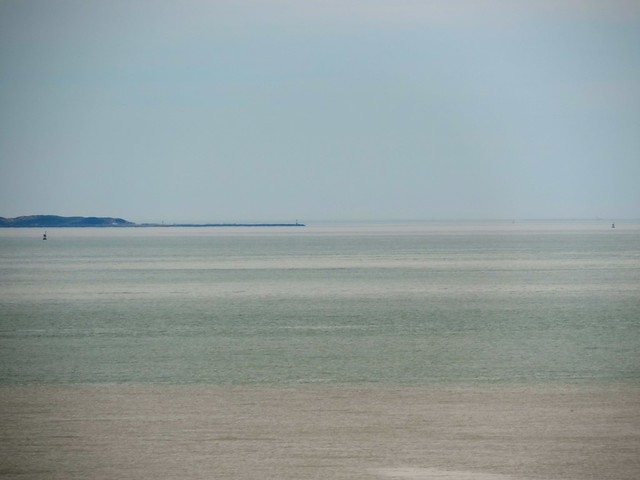
zen seascape

Outcomes

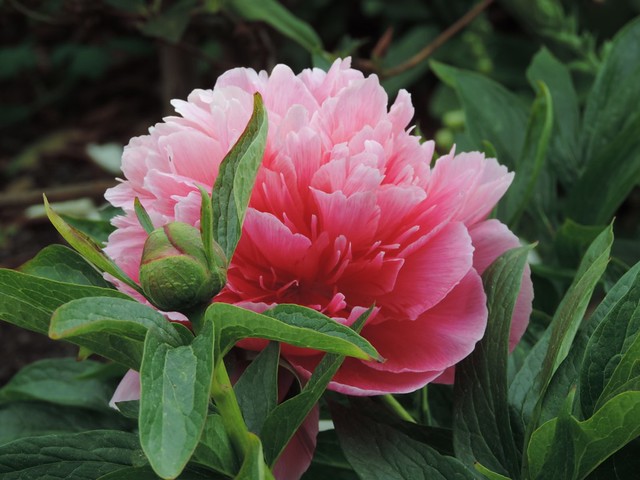
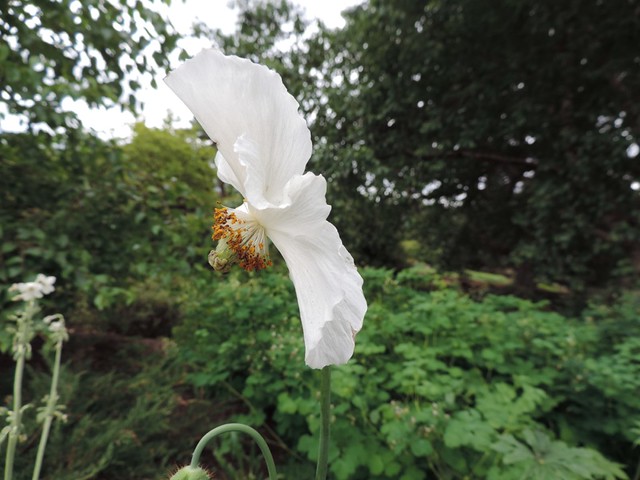
one petal left

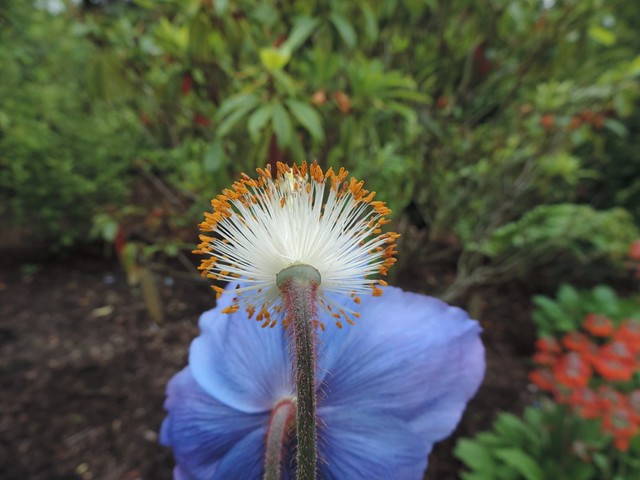
Starting from here, this photo above, we can move to either here –
poppy seeds

or here –
meconopsis

What comes first?

The seed or the flower?

What comes last?

The seed or the flower?

Looked at one way, the seed comes first, grows into the plant which unfurls its petals and reveals its new seeds, attracts the pollinators, then drops the petals, then disperses the seeds to start new plants. Looked at another way, we can start with the flower…..

So, what’s the plant doing? Seeding? Or flowering?

We know, of course, that the plant would not be the plant at all unless it was seeding AND flowering.

Gandhi was once asked “What’s your message?” and he replied

My life is my message

That’s true of all lives isn’t it? Every plant, every animal, every person…..

Soft and gentle

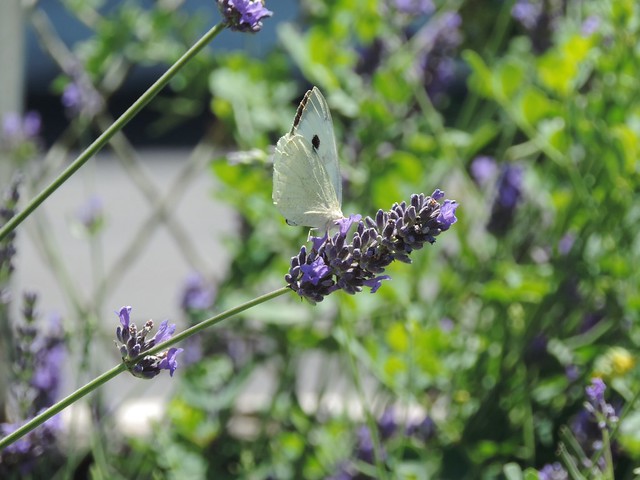
Butterfly on lavender

I recently read an interview with Anne Dufourmantelle, a psychotherapist and philosopher in Paris, who talks about the concept captured by the French word “douceur” (In fact, she has a book entitled “Puissance de la douceur”)

“Douceur” is one of those words which is difficult to translate into English but it has elements of softness, gentleness, goodness, mildness, and sweetness. “Allez-y en douceur!” means “Gently does it!” or “Easy goes it!”. And in the plural, “les douceurs de la vie” translates as “the pleasures of life”

In the interview (and in the book, which I’ve since purchased and read), she talks of the “absolute necessity of ‘la douceur'” in modern life, and I agree with her wholeheartedly.

She says she was looking for a word which would capture the connection between “the body, the spirit, sensation and intention”, and it was the word “douceur” which seemed to best fit the bill.

Let me try to translate a couple of her phrases for you –

“Douceur au sens de force de vie, de puissance, car notre première expérience sensorielle et émotionnelle est d’avoir été enveloppé dans la chaleur et la douceur d’un autre corps…La douceur donne naissance à la vie, elle est, pour l’humain, une nécessité absolue.”

[my translation – Douceur as a life force, a power, because our first sensory and emotional experience is to be enveloped in the warmth and the softness of another body…..La douceur gives birth to life, it is, for the human being, an absolute necessity.]

To make this concept clearer she says that if douceur was a gesture it would be a caress. Isn’t that lovely?

And somewhere (I can’t find it now) I’m sure she says that a flower could be a symbol of “douceur”.

I think she is right that kindness, gentleness, goodness, softness disarms and has great power – it comes from our own sense of vulnerability and that of others. It’s a humble stance – but powerful in the way, as we saw when it was used by Gandhi and others who advocated non-violent resistance. One image which comes to my mind when I think of this is the anti-vietnam war protesters in the 60s giving flowers to the police and the security forces. (OK, I know, the flower power thing went off from “peace and love” to “sex and drugs” but, well, there was a good hearted idea in there!)

Anne Dufourmantelle’s recommendations for how to increase the “douceur” in your life seem completely consistent with those which I find myself writing about again and again in this blog –

She recommends paying attention to details – gestures, facial expressions, the play of the light, all the little, fleeting, amazing things (“toutes ces minuscules chose fugues, merveilleuses…”) which surround us. And she recommends seeking out and, I’d use the word “relishing”, sensations – smells, tastes, sights, sounds, what touches our skin.

I love how she has taken this single concept and used it to link together bodily experiences, a way of engaging with everyday life, and a power of change which can be used to create more goodness in this world.

If you’ve been following this blog for a while you’ll know that the “émerveillment du quotidien” is a key life principle for me.

That French phrase captures the sense of continuous open-ness to wonder. (It means the amazing everyday – more or less!)

But look what I managed to film today!

I’ve seen and heard this little creature buzzing around my garden recently and he never, ever stays still. Not for a second! I think it’s called a “hummingbird moth”.

His wings make a deep buzzing sound so its always obvious when he is around.

Look at the speed of his wings! Look at that long proboscis and how it can curl right up into a spiral! It’s astonishing!

Looking sideways

angel flower

Doesn’t this flower look a bit like an angel?

Or a butterfly if you can’t imagine what an angel might look like!

I read recently that our retinas only register colour in the central 30 degrees of visual field ….the fact that we see a full panorama in colour (even out the edges of our vision) is due to our ability to make up what we are seeing.

Really?

I know that seems a bit incredible, but when you stop to think about it, our eyes convert light energy into electro-chemical signals which are then processed by the neurones in our brains for us to “see” anything, so maybe it’s not such a surprise that we are responsible for “colouring in” most of what we see!

We are incredibly creative organisms with fabulous bodies and powerful imaginations.

Mark Twain said

a person cannot depend on the eyes when imagination is out of focus

Yesterday was the summer solstice. Or to be more globally correct, the “northern solstice”.

I also know that if you live in Scotland, you’d know yesterday was “midsummer’s day” (Although I suspect you’ll have looked out the window and thought “What??!!”)

However, here in France, yesterday is known as the first day of summer. Either way, it was “the longest day”.

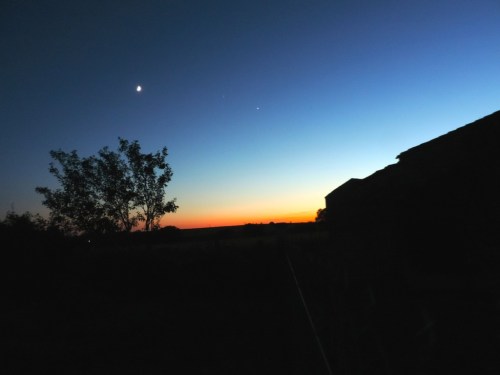
Just after the sun set on the longest day I took this photo from my garden. If you look carefully you can see the moon, Jupiter (just to the right of the moon), and Venus (a bit further to the right). In fact, Jupiter and Venus are moving closer together in the night sky and will converge completely on June 30th.

Were there any celebrations where you live this weekend? Or did you mark this day in some personal way?

I ask because a time like this offers a great opportunity to connect yourself more consciously to the rhythms of the Earth and our solar system.

Deliberately connecting to what is greater than you is a lovely way to develop your quality of your life.

X

In my A to Z of Becoming, I’ve reached the letter “x” again. In Part 1, I took “Xcite” and in part 2, “Xtole” – both, of course, are a play on “x”. I couldn’t think of a verb really beginning with “x” (and, no, I don’t think “xylophone” is a verb meaning to play a “xylophone”, as in “I’m just off to do some xylophoning”)

So this time around I thought I would take “x” as a verb in its own right. What do you think of when you see an “x”?

It has many meanings for us. It can represent a choice. I recently placed an “x” in a box on a voting paper. It can represent a crossroad coming up if we see it on a road sign. It can represent “incorrect”, the opposite of a tick.

But I use “x” mostly as a signifier of love.

You know the way people sign off a communication, whether its birthday greetings in a card, or even a short sms or whatsapp message. Do you do that? If you do, how many such kisses do you use? One, two or three? Or more? And do you vary the number of kisses you give on the basis of the depth of the feeling you have? Or is it just a routine you don’t even notice you are doing?

You know one of the themes of my posts is about awareness and making active choices, so I’m going to suggest two things this week based on “x for kiss”.

One is notice when you write an “x” this week. Pause for a second and ask yourself why you’re doing it, what you feel about the person you are writing to, and just get in touch for a few seconds with the love you feel. Then press send. (Or put the card in the envelope)

The second is give more kisses.

A common sign off in France is “bisous” – which is French for kiss – sometimes that is the word at the end of a greeting, sometimes it is followed by some “x”s. In France, as in many other European countries it is common to greet people you know with kisses – one on each cheek, or three (and if it is three do you start and finish on the left or the right? I haven’t figured that out yet!)

I have “k” for “kiss” in my A to Z so I won’t say more about kissing today.

Enjoy becoming aware of your “x”s this week!

Reflecting on flow

Lillies on the Charente

I took this photo during a boat trip down the Charente river.

I think it’s interesting to see the smoothness of the ripples on the water – this seems so characteristic of this river as it flows through the Charente region of France.

And I think it is amazing to experience the way this characteristic of this geographical feature seems to influence the whole quality of life of this part of the world. There’s an emphasis on slow, on patience and persistence, and on natural seasonal ways of life here. This is the part of the world where I first heard the phrase “Soyons Zen” – meaning “let’s be zen” – a phrase which encapsulates the qualities of being both and present.

Such a river really inspires reflection on the flow of life.

A lick of paint?

French window

Do you look at this image and think – “those shutters could do with a lick of paint”?

I kind of hope you don’t!

Isn’t there a beauty here?

And isn’t part of that beauty the way the world has changed these shutters over the years? People talk about the French aesthetic of “shabby chic” – I’m not sure this is exactly that but it’s pretty common to stumble across examples like this in France.

I wonder if this aesthetic is linked to a Japanese aesthetic about transience, change and the beauty of the “patina of age”.

For me, it certainly touches that “becoming not being” quality that I love so much.

Swans

I bet there’s a good chance you will look at this photo and it will touch your heart.

Looking after wee ones is SO important.

I wonder if we really honour and respect that enough?

Are our societies structured in the way which allows the wee ones to grow and thrive, to reach their full potential?

I think the solutions will lie in developing our heart intelligence, but we need our brain intelligence too.

For a data-driven, brain-focused approach, here’s a video of a presentation by Sir Harry Burns who was Scotland’s Chief Medical Officer until last year. It’s almost half an hour long, and some of it is pretty technical, but Harry Burns is expert at delivering the messages in clear, simple ways. I think the first twenty minutes or so of this presentation will startle you if you haven’t seen this kind of analysis before. The takeaway message is that the way we structure our society, in particular in the physical, emotional and social environments we create, powerfully influences the health and illness paths of individuals right from conception (or earlier?) and the first few months of life. (The last ten minutes or so of this particular presentation goes off into the “patient safety programme” – which is a different issue – in my opinion)