When I was in Clinical Practice and trying to help a patient who was overwhelmed with stress and distress, I’d often draw a simple straight, horizontal line.
I’d say the left hand end of the line represented the day they were born. We know that date. The right hand end of the line was the day they would die. None of us can know that date. And I’d put a cross in the line somewhere around the middle, and say, this cross represents today, this moment. Everything from the day you were born until the present moment, we call the past. Everything from this moment until the day you will die, we call the future. If you pay most of your attention to the past, ruminating, regretting, rehearsing the hurts and wounds of the past, and the rest of your time paying attention to the future, wondering and worrying about whether this or that might happen, filling your mind with “what ifs”, then the one place where you aren’t investing your attention, your energy and your time is here on this day, on this moment.
Imagine if you spent more time and energy focused on the present….this would inevitably be accompanied by less time and energy spent on the past and the future. Doing this bring a double bonus. It helps you become more aware of this moment, more able to savour it, enjoy it, fully live it. And it reduces the time and space in your mind occupied by hurts, wounds, worries and fears.
I still think this model is a bit simplistic. I mean, the past, present and future are not so linear as this little drawing implies. Life tends not to follow straight lines, but rather loops and cycles. However, there’s a value in simplicity, if we take it as a starting point.
I have a couple of large filing cabinet drawers filled with old notebooks which I’ve written and drawn in over several decades. From time to time I pick one out at random and browse it. The one I pulled out this week had a lot of notes about relationship between the past, the present and the future. I’ve always tended to use notebooks for thinking. They aren’t really diaries in the style of I did this, and then that, today. They are more phrases and sentences which have struck me in whatever I was reading at the time, and simple diagrams to help me think something through. They are full of ideas and thoughts and explanatory models.
Here’s what I was exploring about the past, present and future. It seems to me that we access the past through memory, the present through awareness, and the future through imagination. We need all three.
I turn to my memories when I want to reflect. Whether that be at the end of a day, the beginning of new month, or revisiting some shared memories with family or friends.
I turn to awareness to experience the here and now, to find beauty and wonder and joy in the everyday. To find peace and contentment through a savouring of what I see, what I hear, what I smell, touch and taste in this still moment.
I turn to imagination to solve problems, to innovate and create, and to plan.
But, of course, none of this fits well into three separate boxes, or along a single horizontal line. Memory involves imagination. We re-create our experiences and thoughts as we remember. They don’t lie dormant in some drawer, just waiting for us to pull them out and have another look. We know from neuroscience that it isn’t like that. The filing cabinet metaphor of memory is a very poor one. Remembering is a thoroughly active, creative process. We use our imaginations to make our memories.
Imagination draws on memory. If I want to solve a problem, I need to remember what I’ve done to tackle the issue on previous occasions. We don’t innovate and create out of a void. We do it by drawing on both memory and awareness.
And the present moment can only be experienced by a complex, active, ever changing interaction between memory, awareness and imagination. I can’t remember where I read it, but I read we can’t see what we’ve never seen. We need a starting point. We need some foundation ground to every new experience.
But the simple model still works I reckon, because, although all three “zones” are in a constant flux of interaction and change, whatever we focus on grows bigger in our minds. By deliberately paying attention to the present moment, we direct our attention and fill our minds with what we are experiencing right now. And if we really are stuck, devoting so much of our waking hours to memories of wounds and fears and anxiety about futures which might never come, then we denying ourselves the chance to be fully alive today.
One phrase I found in the notebook, was
“Let me understand what was, know what is and imagine what will be.”
I think I must have been reading some of John O’Donohue’s blessings at that point, because I don’t usually write in the form of a prayer or a blessing. But I rather like it….
We look back to understand, piecing together what might have led to what we are experiencing today.
We are aware and awake in this present moment in order to appreciate the world as it is, and,
We dream, daydream, imagine, to look ahead and envision where we want to be.
But there’s something else to add to all this. Nothing is fixed. I think we can accept that when we think of the future. The future isn’t a destination, waiting for us to arrive. It emerges, moment by moment, influenced by the events and experiences of the present. We make choices. Others make choices which affect us. And, we musn’t forget the power of chance. We can also accept that the present isn’t fixed. The present is influenced by past experiences, future possibilities, and the multiple contexts and environments within which we live our everyday. But the past? Isn’t it gone? Isn’t it behind us, written down in black and white? And therefore fixed? I don’t think that’s a helpful way to think about it. It’s said that history is written by those who win the battles, by the conquerors. But those stories are just the stories told from that perspective. Change the perspective, change the focus, and you find other stories. Pull together a diversity of those stories and you get a more holistic view. But, at the very least, even if we can’t change the past, we can change the effects the past is having on us now. That’s how we heal. That’s how we manage to break out of depression, move on from grief….not by changing our past experience, but by changing how we respond and react to it.
And, one more thing……as we try to understand our lives, we look back, we reflect and review. Our default is to see the chain of events as cause and effect. This happened, which led to that, and that led to where I am now.
There’s a danger in relying too heavily on the cause and effect analysis though. Sure, it’s how we learn, but cause and effect is often more a statistical probability than something we can prove. How many times have you read articles about, say a hundred year old man or woman, asked what’s their secret? How did they manage to live so long? Some will say by eating only vegetables, some will say by going to church every week, others will say because they have exercised regularly, but others will tell you it’s because they had a whisky every day and spent as much time as they could with their friends and family. There isn’t A secret. Not A secret which each of us can adopt, nor even a single secret which explains why someone has reached the grand old age of 100.
Thinking about that reminds me of an old joke about Jack Benny who on receiving an award, said “I really don’t deserve this, but, then I have arthritis and I don’t deserve that either!”
Jung believed we didn’t pay enough attention to synchronicity, to the “coincidences” which were connected only through meaning, not through “cause and effect”, and he pointed out that by relying too much on “cause and effect” we tend to ignore the effects of chance. Often, we are just in the right place at the right time (or, conversely, at the wrong place at the wrong time!)
I think we don’t pay enough attention to factors and influences. We’ve learned from science and Public Health, that if we improve the quality of housing people live in, improve the quality of the water they drink and the food they eat, give them more opportunities to be creative and to make good social connections with each other, then many. many more people will experience better, healthier lives…even in the face of randomness, multi-factorial influences, and personal choices.
So, I reckon, as we attempt to have more good days, to lead a more meaningful life, and contribute to the creation of a better world, we need to have a bit of humility, accepting we can never know everything, and we need to accept the reality of change and chance.
Where does that leave me and you?
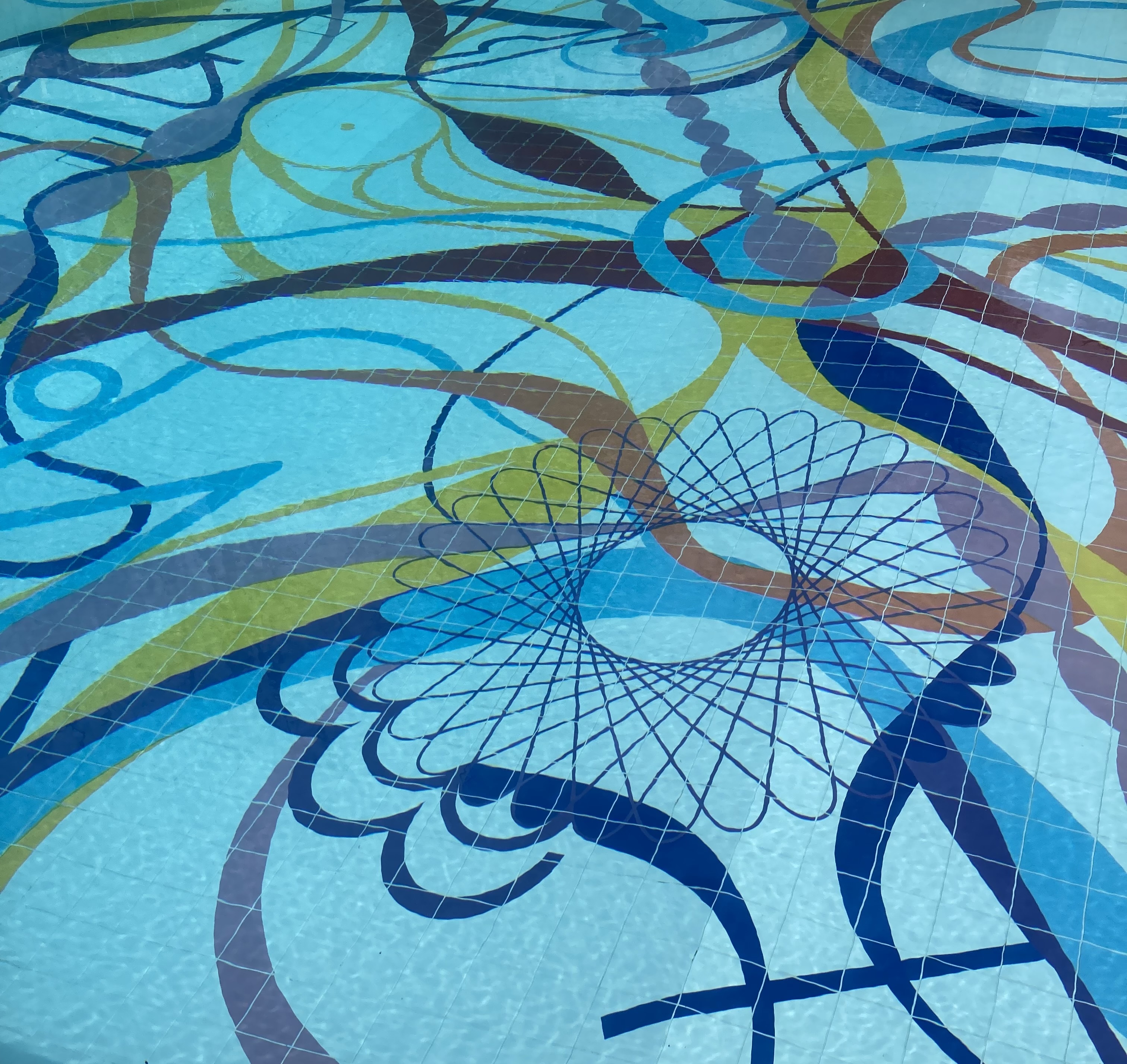
I think it leads right back to that point, or zone, on the straight line I mentioned at the beginning of this piece….the zone marked “the present”. The best we can do is to focus on this moment, this day, this period of our lives, and be aware, consciously choosing to be on the lookout for moments of wonder, beauty, and love. Maybe it’s not a point on a straight line, but an intersection of multiple memories, creative imaginings and awareness…..a bit like that image I put at the beginning.
Savour the day.
I posted this, originally, on my substack which you can find at https://bobleckridge.substack.com/
Please come along and subscribe there, where you can find all my newsletters (15 issues so far, as I write this) and all my podcast episodes (just shared episode 10 this week). That way, you’ll get every newsletter and every podcast episode delivered to your email inbox whenever they are published


Leave a comment